OpenMP is the simplest way to parallelize an existing code on a single node. By adding a few compiler directives to a serial program, you can distribute the work over all the cores of a shared memory machine, without rewriting your algorithms.
In this lecture, we will:
review the shared memory and distributed memory paradigms
understand the general concepts of OpenMP: threads, parallel regions, private and shared variables
learn how to compile and run an OpenMP program
parallelize loops and choose a work scheduling strategy
learn best practices to get good performance with OpenMP
Parallel programming languages
Evolution of programming methods:
MPI is still the dominant programming technique.
The hybrid OpenMP/MPI approach is the most effective on supercomputers.
GPU programming is developing quickly:
CUDA
OpenACC and OpenMP
Message passing directly within the GPU
New specific parallel programming languages are being developed:
Co-array Fortran, PGAS, X10, Chapel...
New runtime systems handle task-based parallelism:
Charm++, HPX, Kokkos
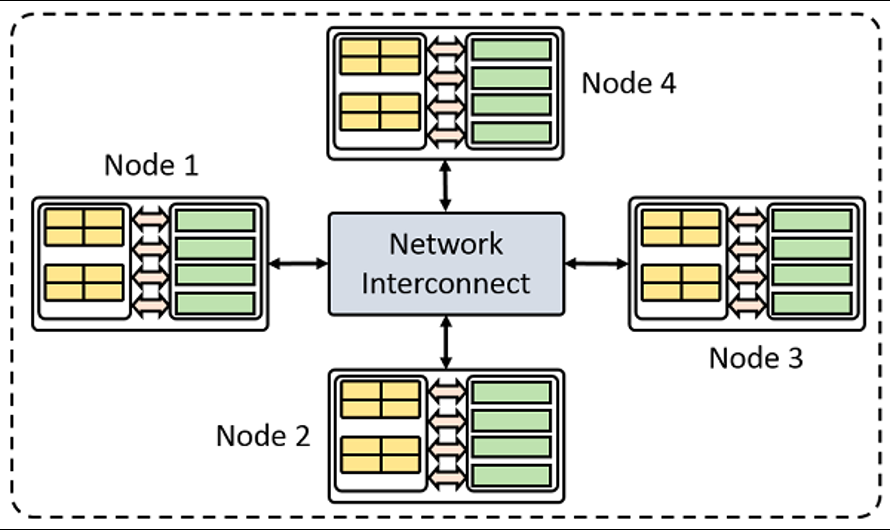
Distributed memory versus shared memory
MPI uses a distributed memory paradigm: data are transferred explicitly between nodes through the network.
OpenMP uses a shared memory paradigm: data are shared implicitly within the node through the Random-Access Memory.
OpenMP history
Multi-threading using directives
During the era of vector processing (mid-90s), many vendors (Cray, NEC, IBM...) were using their own multi-threading directives. On October 28th 1997, they all met and adopted the Open Multi-Processing standard. OpenMP is specified by the Architecture Review Board (ARB).
OpenMP 2.0 (November 2000): modern Fortran constructs
OpenMP 3.0 (May 2008): task-based computing
OpenMP 4.0 (July 2013): external devices (accelerators)
OpenMP 5.0 (November 2018), followed by 5.1, 5.2, and 6.0 (November 2024)
General concepts
Multi-threading
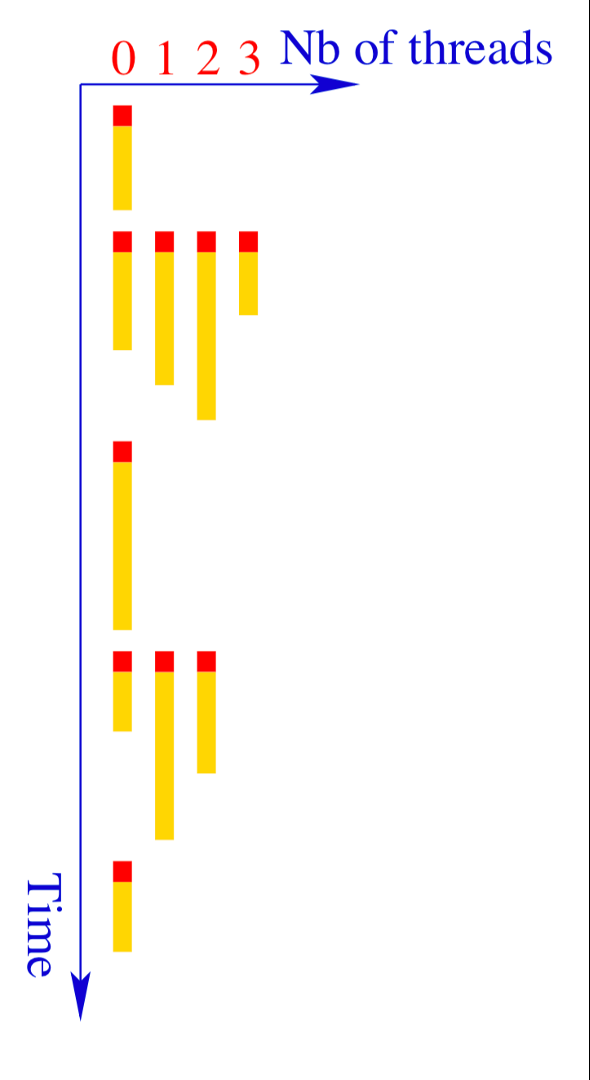
An OpenMP program is executed by only one process, called the master thread. The corresponding piece of code is called a sequential region.
The master thread activates light-weight processes, called the workers or slave threads. This marks in the code the entry of a parallel region.
Each thread executes a task corresponding to a block of instructions. During the execution of the task, variables can be read from or updated in memory.
A variable can be defined in the local memory of the thread, called the stack memory. The variable is then called a private variable.
A variable can be defined in the main shared (RAM) memory, also called the heap. The variable is then called a shared variable.
Compilation
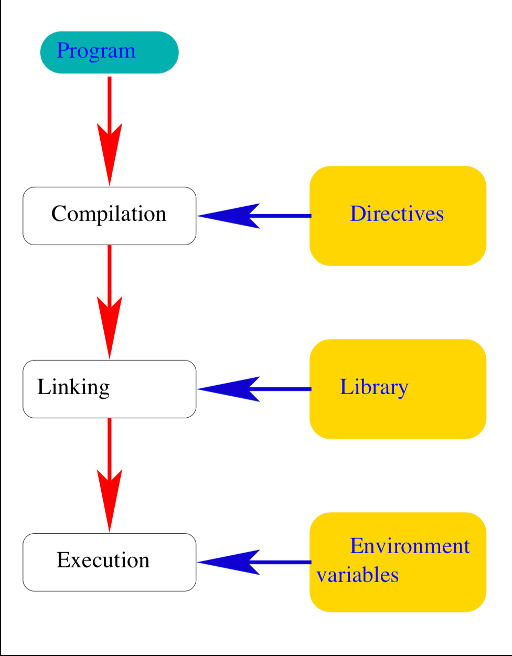
An OpenMP program relies on three ingredients:
Compilation directives and clauses
They are put in the program to create the threads, define the work and data sharing strategy, and synchronize shared variables.
They are considered by the C, C++ or Fortran compilers as mere comment lines unless one specifies
-fopenmp(or-qopenmpfor the Intel compilers) on the compilation command line.
Functions and routines
OpenMP contains several dedicated functions (like MPI). They are part of the OpenMP library that is linked at link time.
Environment variables
OpenMP has several environment variables that can be set at execution time to change the parallel computing behavior.
Example:
$ gfortran -fopenmp prog.f90
$ ifx -qopenmp prog.f90
$ export OMP_NUM_THREADS=4
Parallel region
Shared variables
In a parallel region, by default, the data sharing attribute of variables is shared.
Within a single parallel region, all concurrent threads execute the same code in parallel.
There is an implicit synchronization barrier at the end of the parallel region.
program parallel
  !$ use OMP_LIB
  implicit none
  real    :: a
  logical :: p

  a = 92290. ; p=.false.
  !$OMP PARALLEL
  !$ p = OMP_IN_PARALLEL()
  print *,"A = ",a, &
          "; p = ",p
  !$OMP END PARALLEL
end program parallel
$ gfortran -fopenmp prog.f90
$ export OMP_NUM_THREADS=4
$ ./a.out
A = 92290.0000 ; p = T
A = 92290.0000 ; p = T
A = 92290.0000 ; p = T
A = 92290.0000 ; p = TLines starting with !$ are only compiled when OpenMP is enabled. This is
called conditional compilation: without -fopenmp, the code above is still a
valid serial program.
Private variables
Using the
DEFAULTclause, it is possible to change the default attribute toPRIVATE.If a variable is
PRIVATE, it will be stored in the stack memory of each thread. Its value is undetermined when entering the parallel region.
program parallel
  implicit none
  real :: a

  a = 92000.
  !$OMP PARALLEL DEFAULT(PRIVATE)
    a = a + 290.
    print *,"A = ",a
  !$OMP END PARALLEL
end program parallel
$ gfortran -fopenmp prog.f90
$ export OMP_NUM_THREADS=4
$ ./a.out
A = 290.000000
A = 290.000000
A = 290.000000
A = NaNThe value 92000 set before the parallel region is lost: each thread starts from
an uninitialized copy of a, which here happened to contain 0 or NaN.
Using the
FIRSTPRIVATEclause, it is possible to force the initialization of aPRIVATEvariable to the last value it had outside the parallel region.
program parallel
  implicit none
  real :: a

  a = 92000.
  !$OMP PARALLEL DEFAULT(NONE) &
  !$OMP FIRSTPRIVATE(a)
    a = a + 290.
    print *,"A = ",a
  !$OMP END PARALLEL
  print*,"Out of region, A =",a
end program parallel
$ gfortran -fopenmp prog.f90
$ export OMP_NUM_THREADS=4
$ ./a.out
A = 92290.0000
A = 92290.0000
A = 92290.0000
A = 92290.0000
Out of region, A = 92000.0000Number of threads
The
NUM_THREADS()clause sets the number of threads in a parallel region.OMP_GET_NUM_THREADS()gives the size of the active team.
program parallel
  implicit none

  !$OMP PARALLEL NUM_THREADS(2)
    print *,"Hello !"
  !$OMP END PARALLEL

  !$OMP PARALLEL NUM_THREADS(3)
    print *,"Hi !"
  !$OMP END PARALLEL
end program parallel
$ gfortran -fopenmp prog.f90
$ export OMP_NUM_THREADS=4
$ ./a.out
Hello !
Hello !
Hi !
Hi !
Hi !Parallel loop
Work decomposition
A parallel loop is a do-loop where each iteration is independent from the others.
The work is decomposed by distributing the loop iterations among the threads.
The parallel loop is the one that follows immediately after a
DOdirective.Loop indices are always private integer variables.
Loops without loop indices or while loops are not supported by OpenMP.
Work scheduling
The distribution strategy is set by a
SCHEDULEclause.Proper scheduling can optimize the load-balancing of the work.
By default, the runtime sets a global synchronization at the end of the loop.
The
NOWAITclause can remove the barrier.One can put many
DOdirectives inside aPARALLELregion.
Examples
With the default scheduling, the iterations are divided into 4 contiguous chunks of 1024 iterations, one per thread:
program parallel
  !$ use OMP_LIB
  implicit none
  integer, parameter :: n=4096
  real,dimension(n) :: a
  integer :: i, rank, nb_threads

  !$OMP PARALLEL PRIVATE(rank,nb_threads)
  rank=OMP_GET_THREAD_NUM()
  nb_threads=OMP_GET_NUM_THREADS()
  !$OMP DO
  do i=1,n
     print*,rank,i
     a(i) = 92290. + real(i)
  end do
  !$OMP END DO
  !$OMP END PARALLEL

end program parallel
$ gfortran -fopenmp prog.f90
$ export OMP_NUM_THREADS=4
$ ./a.out | more
1 1025
0 1
3 3073
2 2049
1 1026
0 2
3 3074
2 2050
...With a STATIC schedule and a chunk size of 128, the iterations are distributed
in a round-robin fashion by blocks of 128:
  !$OMP DO SCHEDULE(STATIC,128)
  do i=1,n
     print*,rank,i
     a(i) = 92290. + real(i)
  end do
  !$OMP END DO
$ ./a.out | more
2 257
0 1
1 129
3 385
2 258
0 2
1 130
3 386
...With a RUNTIME schedule, the strategy is chosen at execution time with the
OMP_SCHEDULE environment variable. Here, a GUIDED schedule starts with large
chunks and decreases their size down to a minimum of 16:
  !$OMP DO SCHEDULE(RUNTIME)
  do i=1,n
     print*,rank,i
     a(i) = 92290. + real(i)
  end do
  !$OMP END DO
$ export OMP_SCHEDULE="GUIDED,16"
$ ./a.out | more
0 1
2 1025
3 1793
1 2369
0 2
2 1026
3 1794
1 2370
...Synchronization and reductions
Reductions
In a parallel loop, if one needs to perform a global operation, one uses the
REDUCTIONclause.Supported operations are
logical:
.AND.,.OR.,.EQV.,.NEQV.intrinsic:
MAX,MIN,IAND,IOR,IEORarithmetic:
+,*,-
Each thread computes partial results, which are combined at the end of the parallel loop.
program parallel
  implicit none
  integer, parameter :: n=5
  integer            :: i, s=0, p=1, r=1
  !$OMP PARALLEL
  !$OMP DO REDUCTION(+:s) REDUCTION(*:p,r)
    do i = 1, n
      s = s + 1
      p = p * 2
      r = r * 3
    end do
  !$OMP END PARALLEL
  print *,"s =",s, "; p =",p, "; r =",r
end program parallel
Barriers and race conditions
The directive
!$OMP BARRIERforces the synchronization of all threads within a parallel region.The directives
ATOMICandCRITICALcan be used to force a serial variable update and avoid race conditions.
Best practices
Minimize the number of parallel regions in the code.
Adjust the number of threads to the size of the problem (threads come with overhead).
Always parallelize the outermost loop, on the slowest-varying index of an array (non-consecutive in memory).
Conflicts between threads can lead to poor cache memory management (the so-called cache misses). Level 1 and 2 cache memory management is key to OpenMP performance.
Performance analysis with OpenMP can be done using several functions provided by
OMP_LIBto measure time. The most useful istime = OMP_GET_WTIME(), which gives the elapsed time in seconds.
Memory placement
The performance of your code will depend on the architecture. Be aware of “false” shared memory architectures!
On most present day machines, local cache memory is faster than main RAM memory.
Mapping your data in memory is a key performance factor.
On Linux, the memory is mapped to a given socket on a “first touch” basis. This is very important for “Non-Uniform Memory Access” (NUMA) machines, for which the main memory is not really shared but distributed across the node.