OpenMP lets you use all the cores of a single node, but the largest scientific simulations run on thousands of nodes. To go beyond one node, processes have to communicate explicitly by sending messages to each other over the network. The Message Passing Interface (MPI) is the standard library for doing this.
In this lecture, we will:
review the history of MPI, its implementations, and the tools around it
understand the general concepts of message passing and domain decomposition
learn how to write a basic MPI program
use blocking and non-blocking point-to-point communications
use collective communications
compare MPI and OpenMP, and briefly introduce GPU programming
Parallel programming languages
Evolution of programming methods:
MPI is still the dominant programming technique.
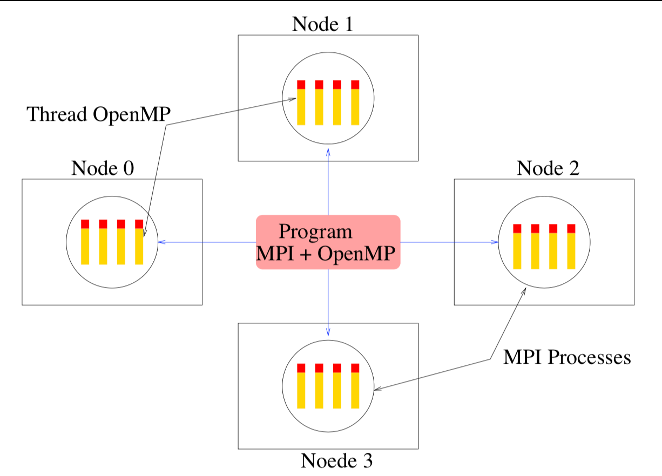
The hybrid OpenMP/MPI approach is the most effective on supercomputers.
GPU programming is developing quickly:
CUDA
OpenACC and OpenMP
Message passing directly within the GPU
New specific parallel programming languages are being developed:
Co-array Fortran, PGAS, X10, Chapel...
New runtime systems handle task-based parallelism:
Charm++, HPX, Kokkos
Distributed memory versus shared memory
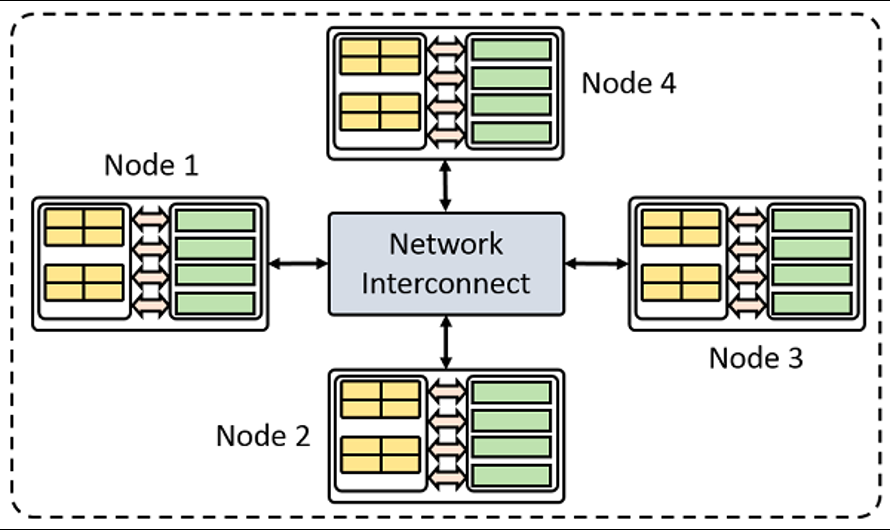
MPI uses a distributed memory paradigm: data are transferred explicitly between nodes through the network.
OpenMP uses a shared memory paradigm: data are shared implicitly within the node through the Random-Access Memory.
MPI history
MPI 1
Version 1.0 (June 1994): 40 different organizations develop the MPI standard, with various subroutines defining the first MPI library
Version 1.1 (June 1995)
Version 1.2 (1997)
Version 1.3 (September 2008): final version
MPI 2
Version 2.0 (July 1997): includes new features intentionally left out of MPI 1, such as dynamic process management, one-sided communication, and parallel I/O
Version 2.1 (June 2008)
Version 2.2 (September 2009)
MPI 3
Version 3.0 (September 2012): includes new features left out of MPI 2, such as non-blocking collective communications, Fortran 2008 bindings, and interfacing with external tools
Version 3.1 (June 2015)
MPI 4
Version 4.0 (June 2021): persistent collectives, partitioned communication, sessions, and large-count routines for million-way parallelism
Version 4.1 (November 2023)
MPI 5
Version 5.0 (June 2025): a standard Application Binary Interface (ABI)
MPI implementations
Open source libraries can be installed on almost any architecture (for example on your laptop):
Vendors also provide their own implementations, for example:
Intel MPI
IBM Spectrum MPI
HPE Cray MPICH
MPI tools
Debuggers and performance analysis tools:
Linaro DDT (formerly Arm DDT)
Scientific libraries:
General concepts
Parallel processing
MPI is a library which allows process coordination and scheduling between millions of processors using a message-passing paradigm.
Message attributes
The message is sent from a source process to a target process: it has a sender address and a recipient address.
The message contains a header with
the identifier of the sending process (sender id)
the type of the message data (datatype)
the length of the message data (data length)
the identifier of the receiving process (receiver id)
The message contains data.
The MPI environment
The messages are managed and interpreted by a runtime system, comparable to a telephone provider, an email system or a postal company.
Messages are sent to a specific address. Receiving processes must be able to classify and interpret incoming messages.
An MPI application is a group of autonomous processes deployed on different nodes, each one executing its own code and communicating with the other processes via calls to routines in the MPI library.
Data distribution
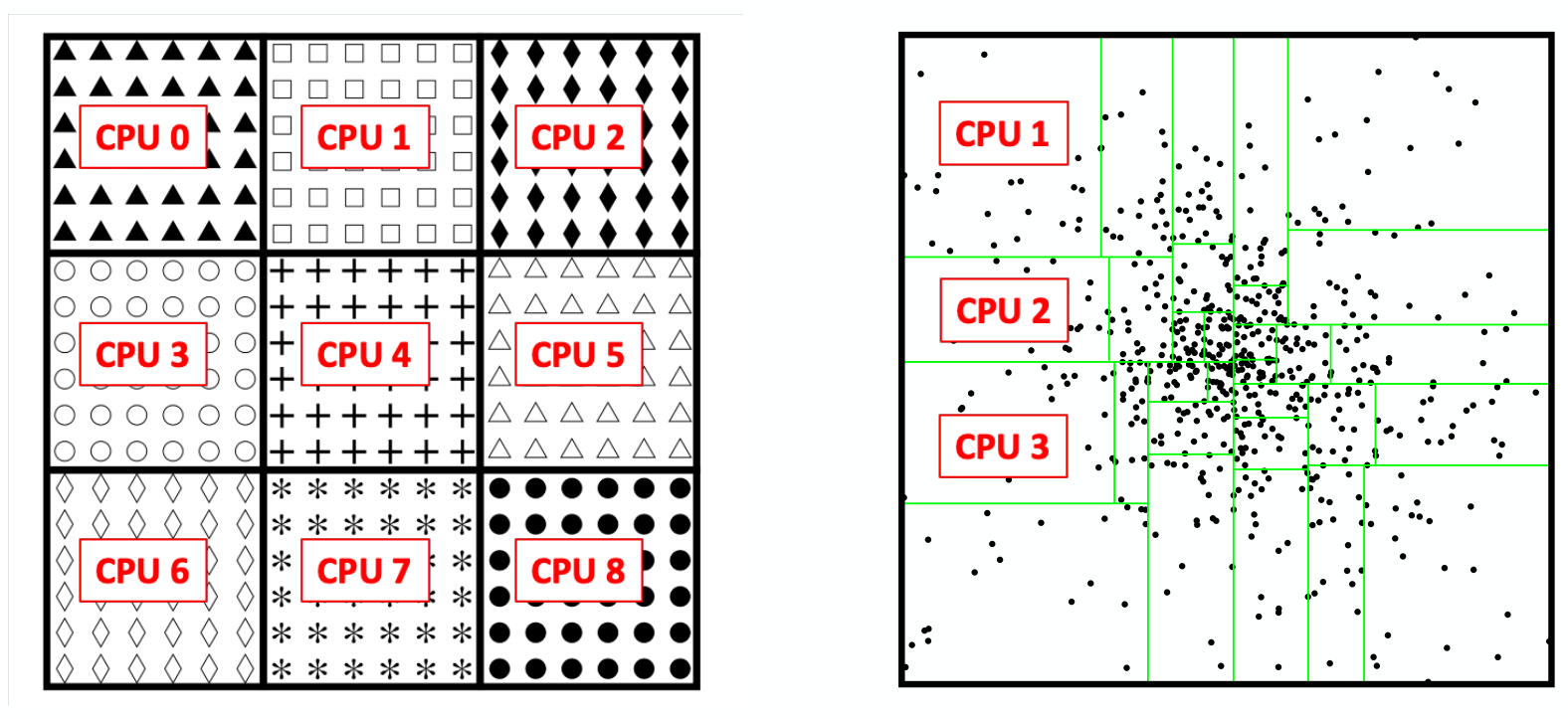
Data (grid cells or particles) are distributed between nodes and cores using a domain decomposition strategy. On the left, a regular grid is split into 9 equal domains. On the right, the domains of a particle simulation adapt to the particle density, so that each process gets roughly the same amount of work.
MPI basics
Setting up the MPI environment
The MPI definitions are made available with:
include 'mpif.h'in Fortran (MPI 1) or#include <mpi.h>in C/C++use mpiin Fortran (MPI 2), oruse mpi_f08for the modern Fortran 2008 bindings
The MPI environment is launched with the MPI_INIT() routine and terminated
with the MPI_FINALIZE() routine.
C syntax:
int MPI_Init(int *argc, char ***argv);
int MPI_Finalize(void);
Fortran syntax:
call MPI_INIT(code)
call MPI_FINALIZE(code)
Who am I?
Each process can query the total number of processes in the communicator
MPI_COMM_WORLD with MPI_COMM_SIZE(), and its own identifier (its rank)
with MPI_COMM_RANK():
program who_am_I
  use mpi
  implicit none
  integer :: nb_procs,rank,code

  call MPI_INIT(code)

  call MPI_COMM_SIZE(MPI_COMM_WORLD,nb_procs,code)
  call MPI_COMM_RANK(MPI_COMM_WORLD,rank,code)

  print *,'I am the process ',rank,' among ',nb_procs

  call MPI_FINALIZE(code)
end program who_am_I
$ mpif90 who_am_I.f90 -o who_am_I
$ mpiexec -n 7 who_am_I
I am the process 3 among 7
I am the process 0 among 7
I am the process 4 among 7
I am the process 1 among 7
I am the process 5 among 7
I am the process 2 among 7
I am the process 6 among 7The processes print in a random order: they all run independently.
Point-to-point communications
Blocking send and receive
program point_to_point
  use mpi
  implicit none

  integer, dimension(MPI_STATUS_SIZE) :: status
  integer, parameter                  :: tag=100
  integer                             :: rank,value,code

  call MPI_INIT(code)

  call MPI_COMM_RANK(MPI_COMM_WORLD,rank,code)

  if (rank == 2) then
     value=1000
     call MPI_SEND(value,1,MPI_INTEGER,5,tag,MPI_COMM_WORLD,code)
  elseif (rank == 5) then
     call MPI_RECV(value,1,MPI_INTEGER,2,tag,MPI_COMM_WORLD,status,code)
     print *,'I, process 5, I received ',value,' from the process 2'
  end if

  call MPI_FINALIZE(code)

end program point_to_point
$ mpiexec -n 7 point_to_point
I, process 5, I received 1000 from the process 2With blocking send and receive, if you are not careful, you can have a deadlock. This means the processes will wait for something that will never happen. The classical mistake is to first call a blocking send towards the next process, and then call a blocking receive from the previous process.
Non-blocking send and receive
Communication costs can be large. The InfiniBand network latency is around a microsecond, equivalent to thousands of processor cycles. One has to add the cost of the message itself (limited by the bandwidth of the InfiniBand network, around 10 GB/s).
Non-blocking routines can be used to perform calculations in parallel to the communication (an additional level of parallelism). There is no risk of deadlock, but there is a risk of memory leak if the communication is not properly terminated.
Non-blocking send:
MPI_ISEND()Non-blocking receive:
MPI_IRECV()Wait or test:
MPI_WAIT(),MPI_TEST()
The communication buffers, however, cannot be used before the proper completion of the send or receive. The user needs to test that the communication is successful in order to proceed with the data, which leads to a higher algorithmic complexity.
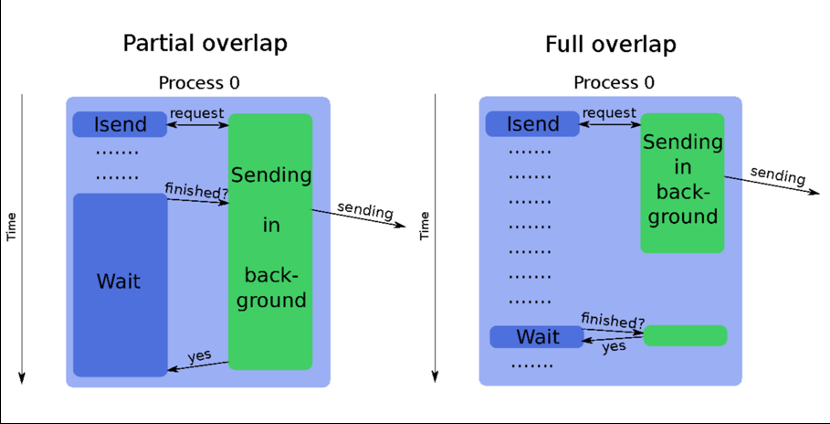
Computation-communication overlap.
Example: halo exchange
A classical use case is a stencil computation on a 2D grid decomposed into domains. Each process needs the values of the cells along the boundaries of its 4 neighbors (North, South, West, and East), which are stored in extra “ghost” cells around its own domain.
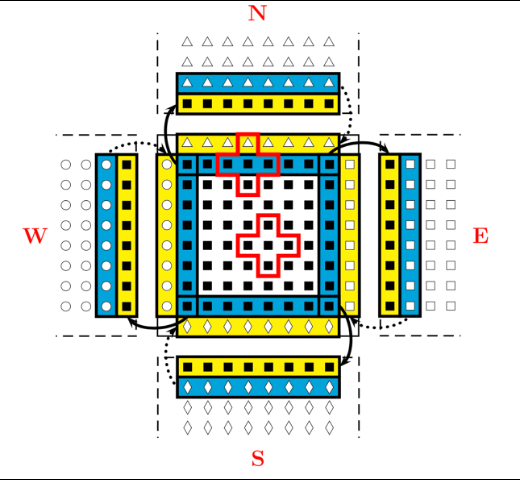
The communications with the 4 neighbors are started with non-blocking calls. The
derived datatypes rowtype and columntype describe a row and a column of the
array, and the array indices of the first element of each row or column are
omitted here for brevity:
SUBROUTINE start_communication(u)
  ! Send to the North and receive from the South
  CALL MPI_IRECV( u(,), 1, rowtype, neighbor(S), &
       tag, comm2d, request(1), code)
  CALL MPI_ISEND( u(,), 1, rowtype, neighbor(N), &
       tag, comm2d, request(2), code)

  ! Send to the South and receive from the North
  CALL MPI_IRECV( u(,), 1, rowtype, neighbor(N), &
       tag, comm2d, request(3), code)
  CALL MPI_ISEND( u(,), 1, rowtype, neighbor(S), &
       tag, comm2d, request(4), code)

  ! Send to the West and receive from the East
  CALL MPI_IRECV( u(,), 1, columntype, neighbor(E), &
       tag, comm2d, request(5), code)
  CALL MPI_ISEND( u(,), 1, columntype, neighbor(W), &
       tag, comm2d, request(6), code)

  ! Send to the East and receive from the West
  CALL MPI_IRECV( u(,), 1, columntype, neighbor(W), &
       tag, comm2d, request(7), code)
  CALL MPI_ISEND( u(,), 1, columntype, neighbor(E), &
       tag, comm2d, request(8), code)
END SUBROUTINE start_communication

SUBROUTINE end_communication(u)
  CALL MPI_WAITALL(2*NB_NEIGHBORS, request, tab_status, code)
END SUBROUTINE end_communication
While the messages are in flight, each process updates the interior of its domain, which does not depend on the ghost cells. Once the communications are completed, it updates the 4 boundaries:
DO WHILE ((.NOT. convergence) .AND. (it < it_max))
  it = it +1
  u(sx:ex,sy:ey) = u_new(sx:ex,sy:ey)

  ! Exchange value on the interfaces
  CALL start_communication( u )

  ! Compute u
  CALL calcul( u, u_new, sx+1, ex-1, sy+1, ey-1)

  CALL end_communication( u )

  ! North
  CALL calcul( u, u_new, sx, sx, sy, ey)
  ! South
  CALL calcul( u, u_new, ex, ex, sy, ey)
  ! West
  CALL calcul( u, u_new, sx, ex, sy, sy)
  ! East
  CALL calcul( u, u_new, sx, ex, ey, ey)

  ! Compute global error
  diffnorm = global_error (u, u_new)

  convergence = ( diffnorm < eps )

END DO
Collective communications
General concepts
Collective communications make a series of point-to-point calls, hidden from the user, within one single subroutine.
A collective communication always involves all processes within the communicator.
A collective communication is blocking. It is finished when all the necessary point-to-point communications are completed.
There is no need to add a barrier.
There is no need to specify tags.
Types of collectives
Global synchronization (wait for all processes to arrive):
MPI_BARRIER()Collective transfer of fixed size data:
send data from one process to all others:
MPI_BCAST()split data from one process into all others:
MPI_SCATTER()collect data from all processes into one:
MPI_GATHER()same but collect into all:
MPI_ALLGATHER(),MPI_ALLTOALL()
Collective transfer of variable size data:
MPI_SCATTERV(),MPI_GATHERV(),MPI_ALLGATHERV(),MPI_ALLTOALLV()Collective transfer plus an additional operation on the data (
MAX,MIN,+,*...):MPI_REDUCE(),MPI_ALLREDUCE()
Scatter
Process 2 splits its array of 8 values into blocks of 2 values, and sends one block to each process (including itself):
program scatter
  use mpi
  implicit none

  integer, parameter                :: nb_values=8
  integer                           :: nb_procs,rank,block_length,i,code
  real, allocatable, dimension(:)   :: values,data

  call MPI_INIT(code)
  call MPI_COMM_SIZE(MPI_COMM_WORLD,nb_procs,code)
  call MPI_COMM_RANK(MPI_COMM_WORLD,rank,code)
  block_length=nb_values/nb_procs
  allocate(data(block_length))

  if (rank == 2) then
     allocate(values(nb_values))
     values(:)=(/(1000.+i,i=1,nb_values)/)
     print *,'I, process ',rank,'send my values array : ',&
             values(1:nb_values)
  end if

  call MPI_SCATTER(values,block_length,MPI_REAL,data,block_length, &
                   MPI_REAL,2,MPI_COMM_WORLD,code)
  print *,'I, process ',rank,', received ', data(1:block_length), &
          ' of process 2'
  call MPI_FINALIZE(code)

end program scatter
$ mpiexec -n 4 scatter
I, process 2 send my values array : 1001.00000 1002.00000 1003.00000 1004.00000 1005.00000 1006.00000 1007.00000 1008.00000
I, process 0 , received 1001.00000 1002.00000 of process 2
I, process 1 , received 1003.00000 1004.00000 of process 2
I, process 3 , received 1007.00000 1008.00000 of process 2
I, process 2 , received 1005.00000 1006.00000 of process 2All reduce
Each process contributes a value, and all processes receive the product of all the values, here :
program allreduce

  use mpi
  implicit none

  integer :: nb_procs,rank,value,product,code

  call MPI_INIT(code)
  call MPI_COMM_SIZE(MPI_COMM_WORLD,nb_procs,code)
  call MPI_COMM_RANK(MPI_COMM_WORLD,rank,code)

  if (rank == 0) then
     value=10
  else
     value=rank
  endif

  call MPI_ALLREDUCE(value,product,1,MPI_INTEGER,MPI_PROD,MPI_COMM_WORLD,code)

  print *,'I, process ',rank,', received the value of the global product ',product

  call MPI_FINALIZE(code)

end program allreduce
$ mpiexec -n 7 allreduce
I, process 6 , received the value of the global product 7200
I, process 2 , received the value of the global product 7200
I, process 0 , received the value of the global product 7200
I, process 4 , received the value of the global product 7200
I, process 5 , received the value of the global product 7200
I, process 3 , received the value of the global product 7200
I, process 1 , received the value of the global product 7200OpenMP versus MPI
MPI is a multi-process model, for which communication between processes is explicit and under the responsibility of the programmer.
OpenMP is a multi-thread model, within a single process. Communication between threads is implicit. The management of communication is under the responsibility of the compiler (and the operating system).
MPI is used on distributed memory architectures (clusters with an InfiniBand network).
OpenMP is used on shared memory, multi-core architectures.
On a cluster of many large shared memory nodes, the hybrid approach (OpenMP within nodes and MPI across nodes) can be optimal.
Graphics Processing Units (GPU)
GPU model
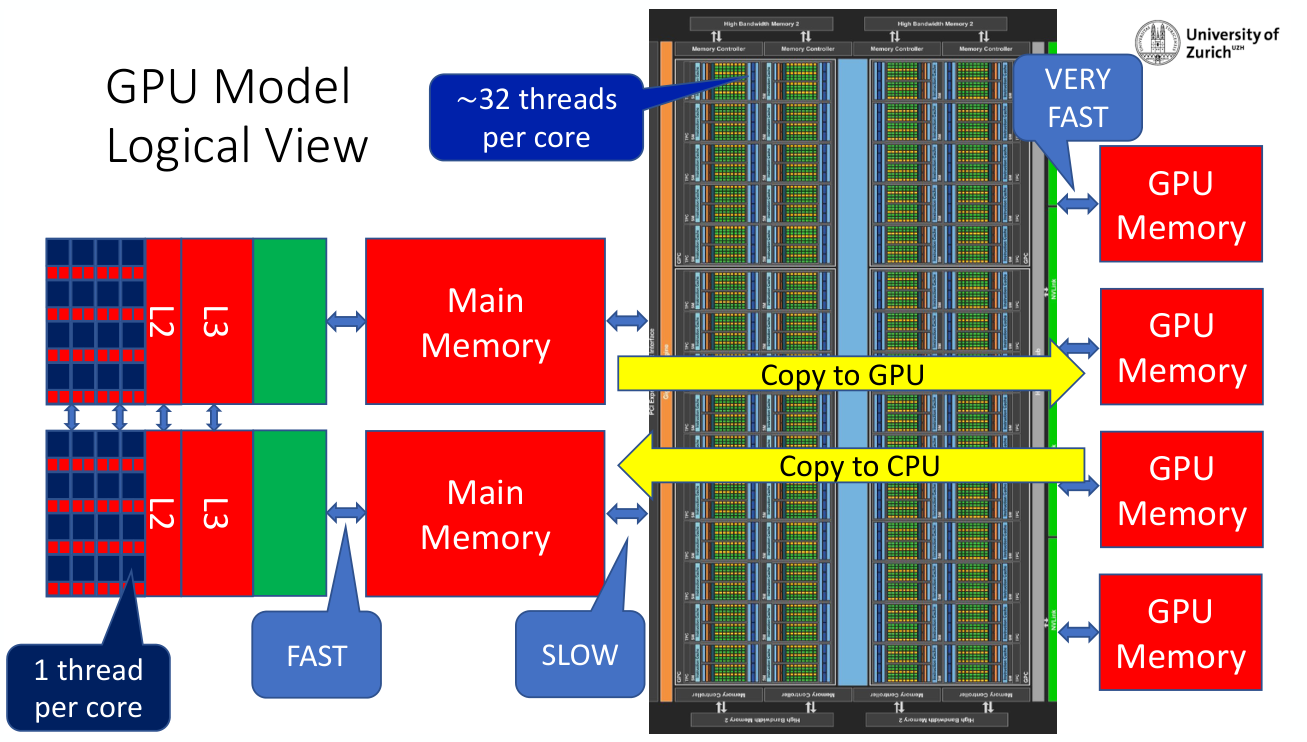
A CPU core runs 1 thread at a time, with fast access to its main memory. A GPU runs about 32 threads per core, with very fast access to its own memory. But data has to be copied from the CPU main memory to the GPU memory and back, which is slow.
GPU programming
CUDA: NVIDIA GPUs are usually programmed using the vendor proprietary language CUDA. It is interfaced with C and C++ to create GPU kernels.
Warning: CUDA requires a complete rewrite of the computing intensive sections of the code, and lacks portability. Extracting maximum performance is difficult.
OpenACC: similar to OpenMP, it uses directives to load data on and retrieve data from the GPU, and to translate C and Fortran code into GPU kernels.
Better portability, but it usually also requires a rewrite of the routines.
Available in the NVIDIA HPC SDK (formerly the PGI compiler suite) and in GCC.
OpenMP: since version 4.5, OpenMP allows offloading of parallel sections to the GPU using the
targetdirective.Implemented in the GNU, Intel, LLVM, and NVIDIA compilers.
New generation of compilers and frameworks: the goal is to hide the dirty details from the programmer. Legion is an example of a compiler and runtime system. Kokkos is an example of a framework.
Conclusion
Parallel computing methods:
MPI is still the dominant programming technique.
The hybrid OpenMP/MPI approach is the most effective on supercomputers.
GPU programming is developing quickly:
CUDA
OpenACC and OpenMP
Message passing directly within the GPU
New specific parallel programming languages are being developed:
Co-array Fortran, PGAS, X10, Chapel...
New runtime systems handle task-based parallelism:
Charm++, HPX, Kokkos