For decades, scientific codes got faster for free: each new generation of processors ran at a higher clock frequency. That free lunch is over. Today, performance gains come almost exclusively from parallelism, and scientific software has to be written to exploit many cores, many nodes, and accelerators.
In this lecture, we will:
review Moore’s law and why processor frequency has stopped increasing
understand the memory wall and the evolution of supercomputer hardware
learn the two fundamental laws of parallel processing: Amdahl’s law and Gustafson’s law
get an overview of the communication networks and programming languages used for parallel computing
Open Multi-Processing (OpenMP)
Message Passing Interface (MPI)
Graphics Processing Units (GPU)
Moore’s law
Statement of the law
Gordon Moore, a founder of Intel, stated in 1965 that:
The number of transistors that can be placed on an integrated circuit at a reasonable cost doubles every two years.
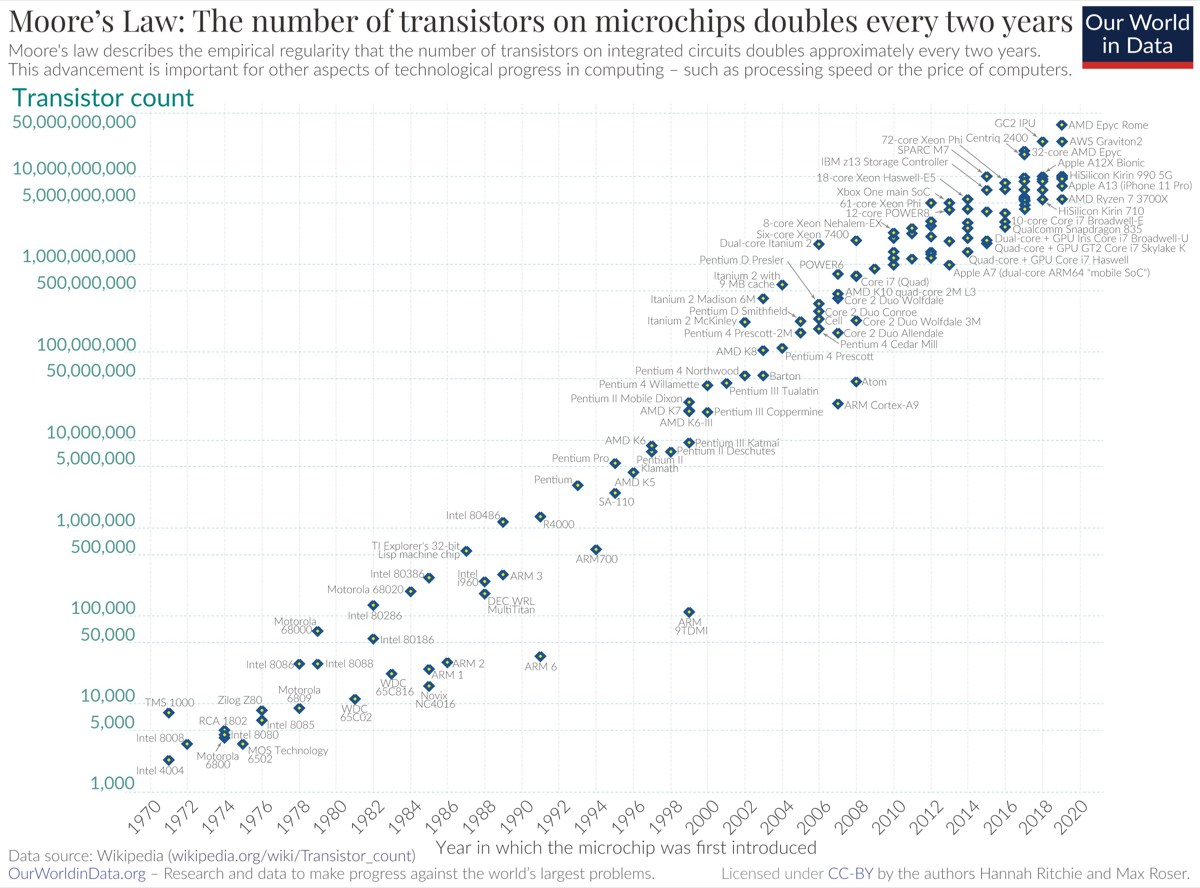
Data source: Wikipedia; figure from OurWorldInData.org, licensed under CC-BY by Hannah Ritchie and Max Roser.
Hardware evolution
Processor frequency has reached a plateau around 3 GHz since 2002-2004, but Moore’s law is still true.
Instead, we get more cores per chip (many-core architectures, GPUs...).
Energy consumption and cost
The dissipated electric power scales as the clock frequency to the cube.
The dissipated power per square cm is limited by cooling.
Increasing the frequency is therefore no longer an option: the extra transistors are used to add more cores instead.
The memory wall
Von Neumann architecture
Programming instructions (stored-program) and data share the memory unit. They are loaded into the Central Processing Unit (CPU) for execution. Results are written back to the memory unit.
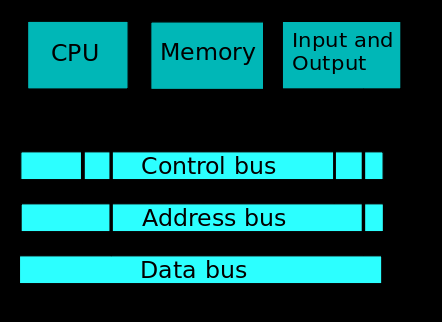
The Von Neumann bottleneck
Memory bandwidth is not increasing as quickly as processor computing power.
Memory latency is decreasing very slowly.
The number of computing cores per memory unit is increasing.
Consequences and solutions
The CPU wastes cycles while waiting for data.
Introduction of cache memory (L1, L2, L3).
Parallel access to memory (vector architectures, AVX).
Supercomputer trends in the Top500
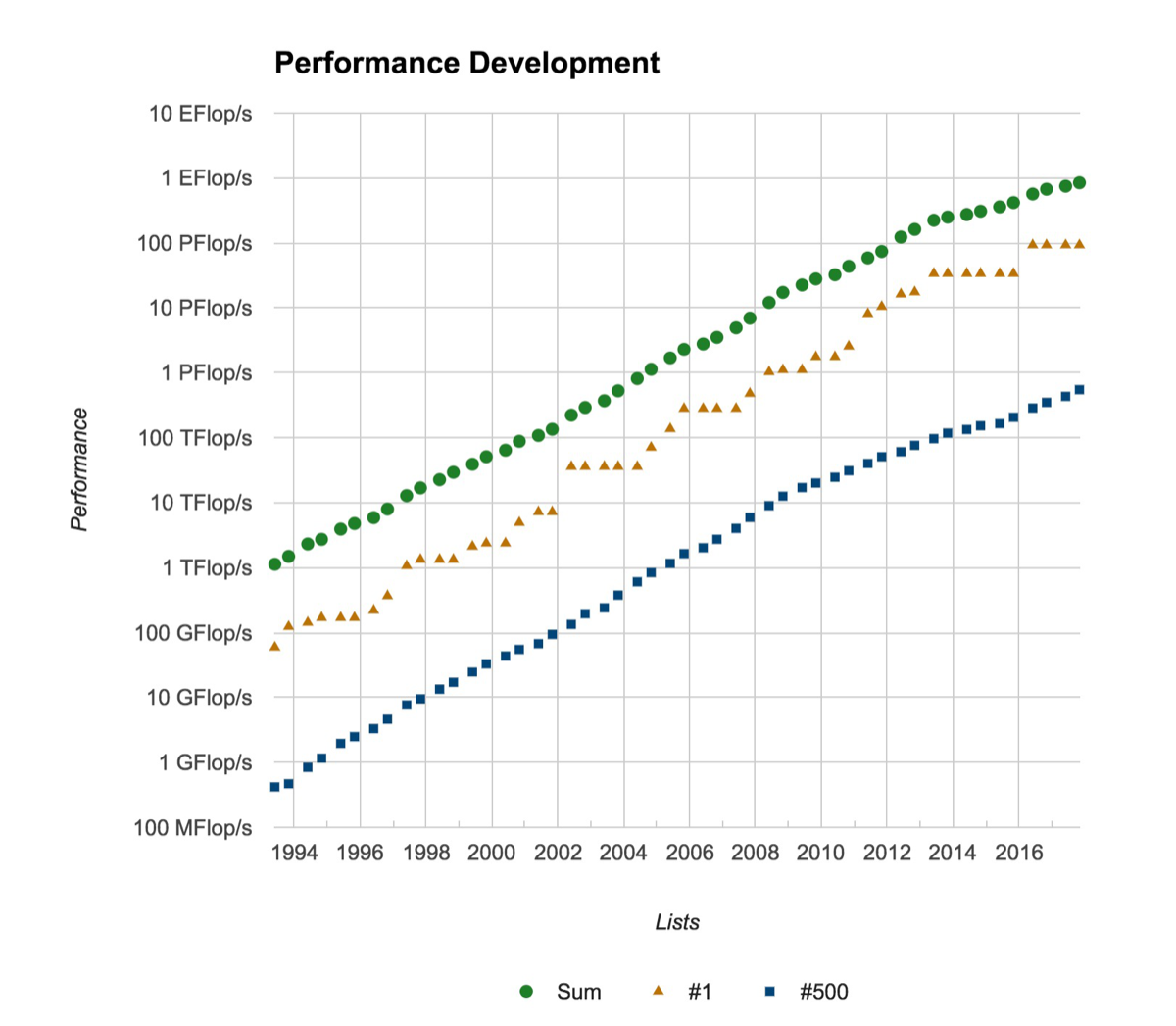
The Top500 list ranks the fastest computers in the world twice a year. It gives a nice view of how supercomputers have evolved.
Performance
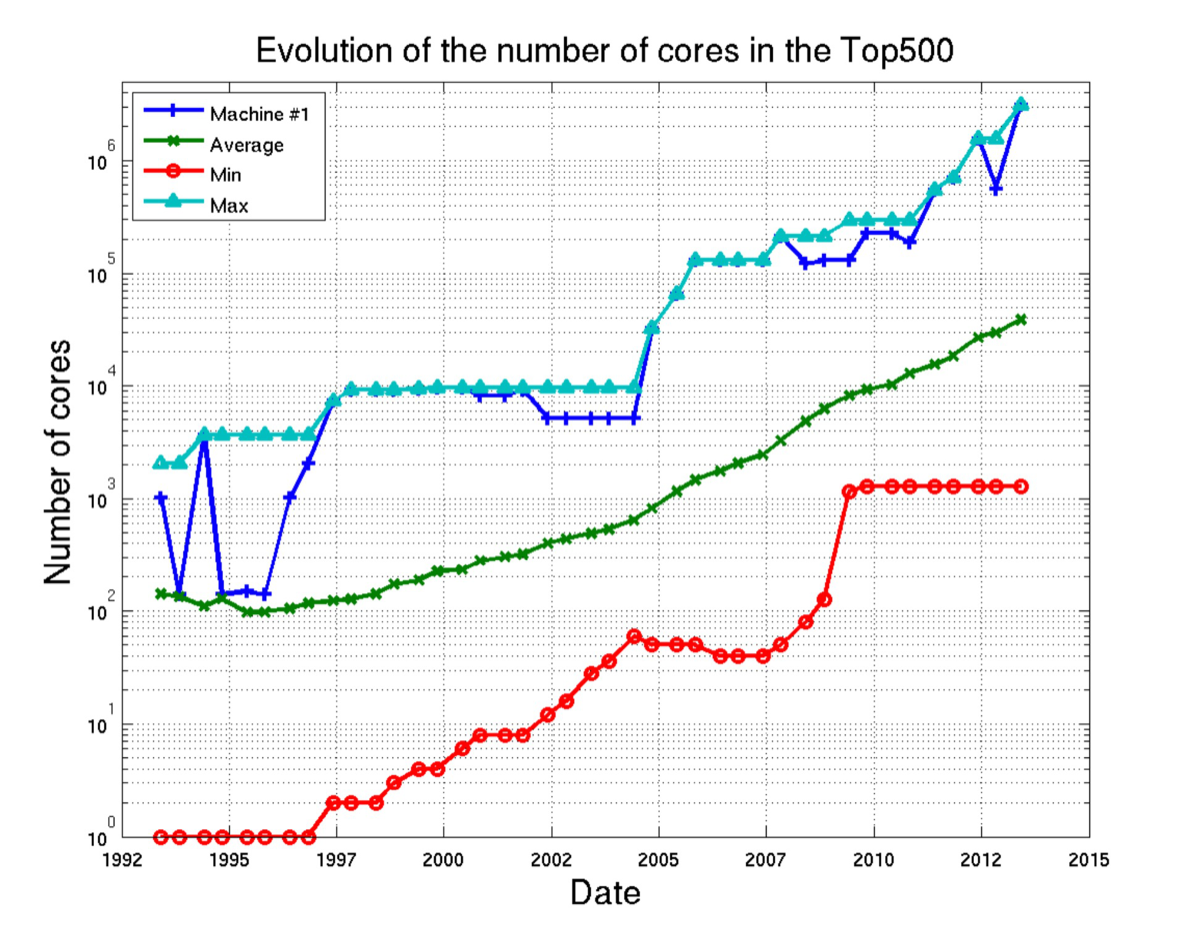
Number of cores
Performance per core
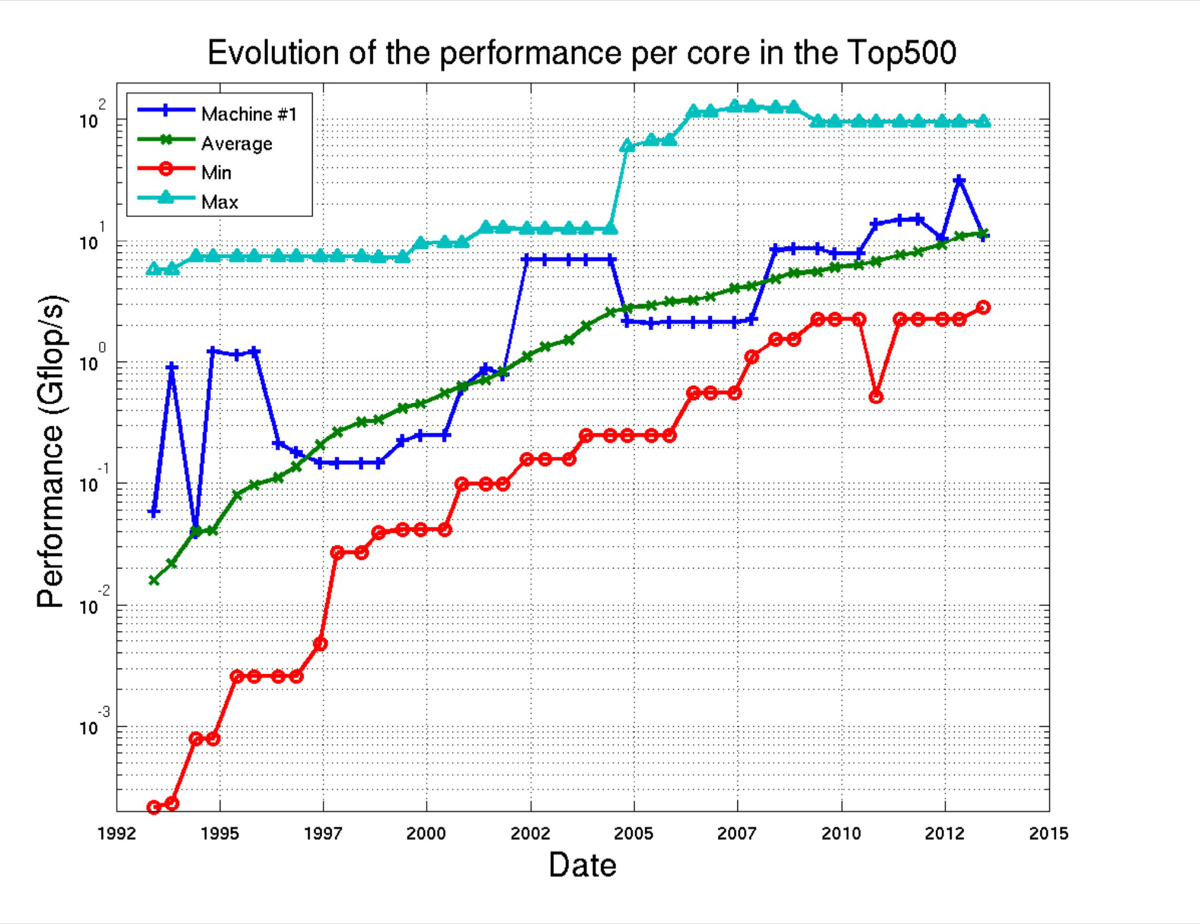
The total performance keeps growing exponentially, but this growth is now driven by the number of cores, while the performance of each individual core has plateaued.
Parallel processing
Amdahl’s law
Gene Amdahl (1967) derived the theoretical maximum speedup obtained by ideally parallelizing a code, for a given problem with a fixed size:
where
is the execution time of the serial code
is the execution time of the parallel code
is the fraction of the code that is not parallel
is the number of processors
In the limit of an infinite number of processors, the speedup saturates:
Strong scaling
Amdahl’s law describes strong scaling: the problem size is fixed, and we add more cores to solve it faster. The theoretical maximum speedup is:
| Cores | = 0 | 0.01% | 0.1% | 1% | 2% | 5% | 10% | 25% | 50% |
|---|---|---|---|---|---|---|---|---|---|
| 10 | 10 | 9.99 | 9.91 | 9.17 | 8.47 | 6.90 | 5.26 | 3.08 | 1.82 |
| 100 | 100 | 99.0 | 91.0 | 50.2 | 33.6 | 16.8 | 9.17 | 3.88 | 1.98 |
| 1000 | 1000 | 909 | 500 | 91 | 47.7 | 19.6 | 9.91 | 3.99 | 1.998 |
| 10000 | 10000 | 5000 | 909 | 99.0 | 49.8 | 19.96 | 9.99 | 3.99 | 2 |
| 100000 | 100000 | 9091 | 990 | 99.9 | 49.9 | 19.99 | 10 | 4 | 2 |
| 10000 | 1000 | 100 | 50 | 20 | 10 | 4 | 2 |
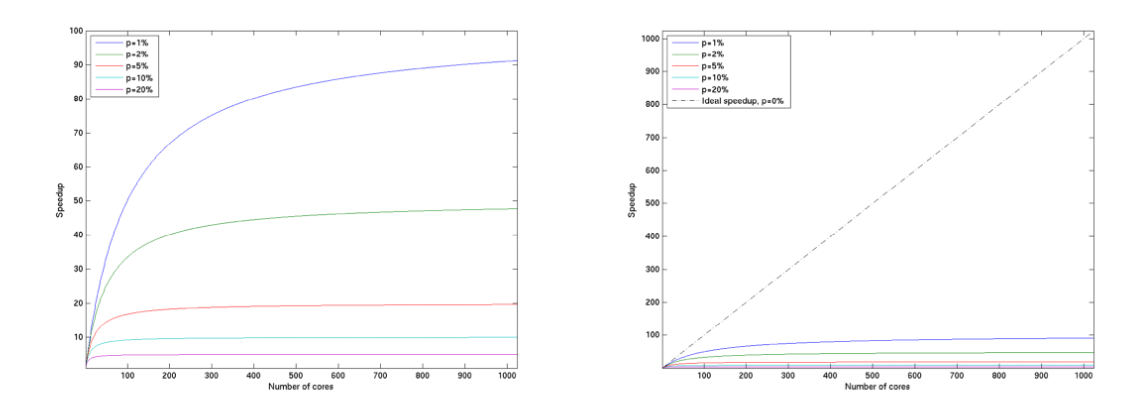
Even with only 1% of non-parallel code, you can never go faster than 100 times the serial code, no matter how many cores you use. The right panel compares these curves to the ideal speedup ().
Gustafson’s law
John Gustafson and Edwin Barsis (1988) derived the theoretical maximum speedup obtained by ideally parallelizing a code for a problem of constant size per core:
Assuming that the execution time of the non-parallel part of the code remains constant, one has:
Weak scaling
Gustafson’s law describes weak scaling: the problem size grows with the number of cores. This law is more optimistic than Amdahl’s law:
In both laws, everything is determined by , the non-parallel fraction of the code. Reducing is called “parallel code optimization”.
Hardware evolution
Technical trends
Computing power is doubling every year.
Massively parallel and many-core architectures are dominant.
Since 2010, Graphics Processing Units have become a key player.
Hardware complexity is increasing (hybrid systems, multiple cache layers).
Memory per core is plateauing or decreasing.
Performance per core is plateauing.
Disk Input/Output bandwidth is increasing very slowly.
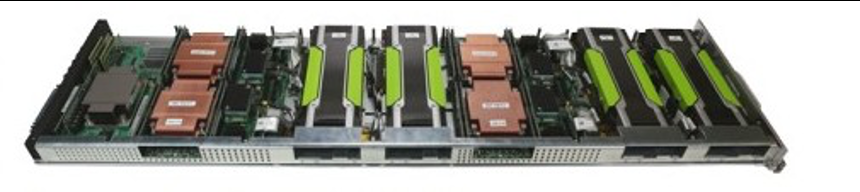
A Cray XC50 blade with GPUs.
Consequences
It is necessary to exploit many (relatively slow) cores.
The memory per core is constant or even decreasing (memory limited).
The raw performance of individual cores is not increasing anymore.
Higher level of parallelism and I/O bottlenecks.
More complex architectures (cache levels, accelerators, latency...).
Multi-disciplinary approach, concept of “co-design”.
Communication network
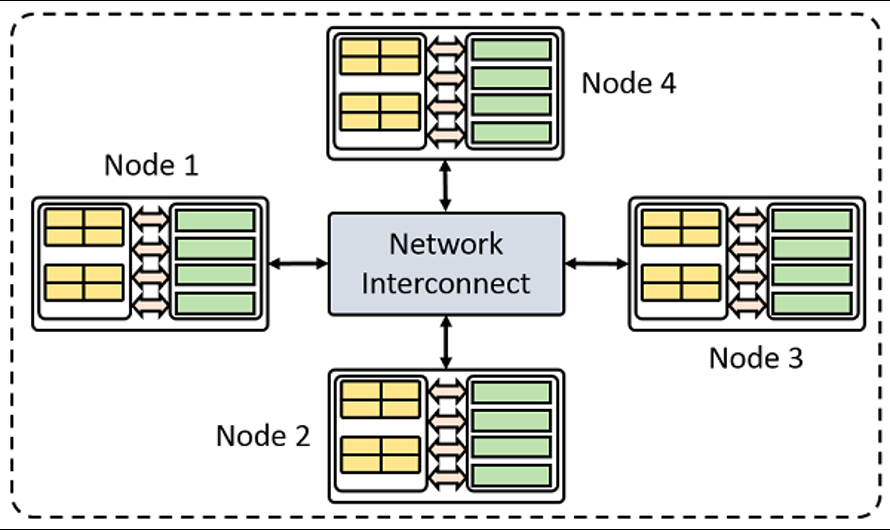
Connecting millions of processors requires a high-performance network.
Most existing systems use “InfiniBand” or variations.
A network switch is needed to interconnect all the nodes.
High-quality fiber cables are needed to connect each node to the switch.
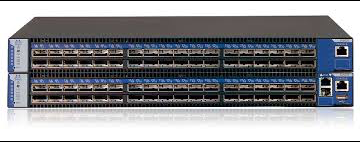
The fat-tree network is a non-blocking network topology invented by Charles Clos (1953). Depending on how many switches you can afford, you might choose blocking configurations instead.
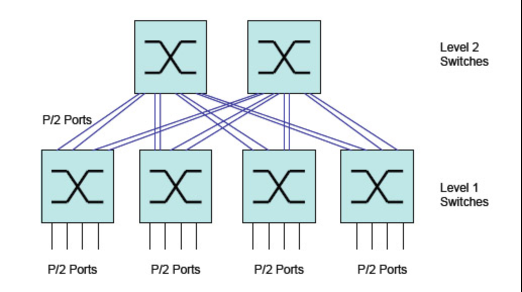
See for example https://
The key network parameters (switches and cables) are the latency and the bandwidth. For an InfiniBand network, the latency is 0.5-1 microsecond, and the bandwidth is 5-10 GB/s.
Parallel programming languages
Evolution of programming methods:
MPI is still the dominant programming technique.
The hybrid OpenMP/MPI approach is the most effective on supercomputers.
GPU programming is developing quickly:
CUDA
OpenACC and OpenMP
Message passing directly within the GPU
New specific parallel programming languages are being developed:
Co-array Fortran, PGAS, X10, Chapel...
New runtime systems handle task-based parallelism:
Charm++, HPX, Kokkos
Distributed memory versus shared memory
MPI uses a distributed memory paradigm: data are transferred explicitly between nodes through the network.
OpenMP uses a shared memory paradigm: data are shared implicitly within the node through the Random-Access Memory.